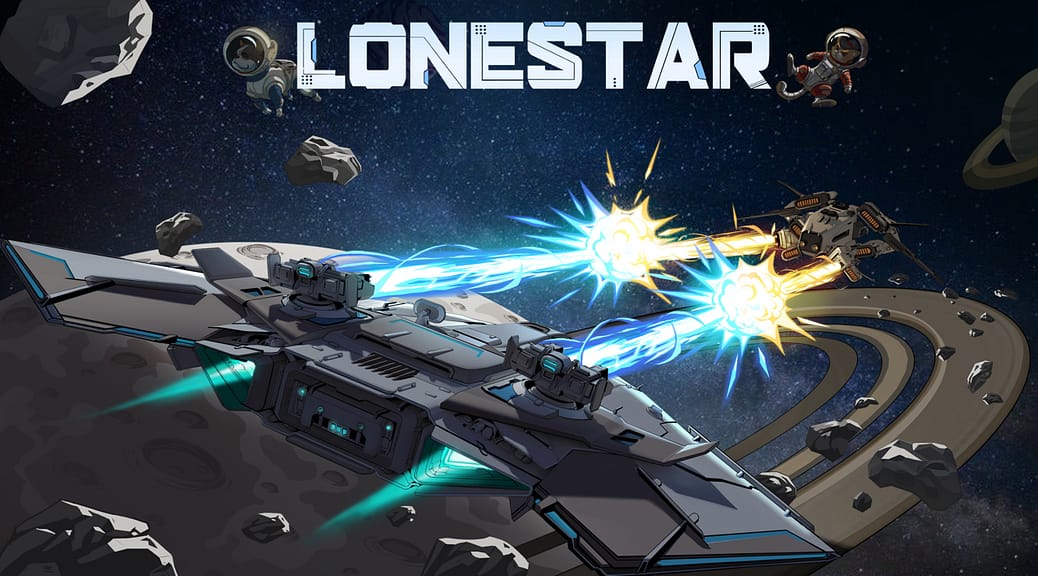
LONESTAR
I’ve liked nearly every roguelike deckbuilder I’ve played, and as such, my personal recommendation list on my Custom Steam Recommendations app is absolutely swarming with the things. Even among that competition, LONESTAR has been ranked extremely high, although the degree to which it even is a deckbuilder is debatable. It’s closest to the already-tenuously-included dice-based side of the genre, along the lines of Dicey Dungeons, then superficially crossed with FTL. That’s insofar as it’s similar to anything that already exists. I can’t think of another game where the primary combat mechanic is laser tug-of-war executed via the manipulation of colour-coded numerical energy through an insanely customizable array of spaceship-mounted machines. My recommendation algorithm doesn’t have an explicit “uniqueness” metric, so either the convergence of my ratings organically reveals a pattern of preferring unique games, or LONESTAR’s high standing was a fortuitous fluke.
The most gratifying thing about this game (as someone who both wants to enjoy games and wants apps that they program to work right) is that, if you told me it was designed to appeal to me specifically, I’d believe you. Even ignoring its genre, it does a number of things that I’ve highlighted as preferences in the past. The exact outcome of each action is shown before it’s taken, and the expected reliance on chance is controlled using a clever primary/backup draw pile system, all of which allow you to consistently take your time and sleuth out optimal moves. The gameplay is wonderfully deep, too. Players need to balance gradual and burst damage, each playable and opposing ship has its own special mechanic, and there are hundreds of upgradable components and passive traits to combine.
Where the game falters, perhaps unsurprisingly, is in aspects that I don’t even know how I could quantify for the purposes of a recommendation app, starting with the most nebulous of all media concepts: vibes. LONESTAR’s art style is forgettable and reminiscent of a high-tier 2000s Flash game. Its narrative is even less noteworthy, featuring a smattering of space Western worldbuilding and a premise that never evolves beyond “You are a bounty hunter.” The writing could perhaps be more engaging if it weren’t for the subpar translation; it only messed up my gameplay choices once or twice, but it did regularly require me to slowly parse what I was reading in order to make sense of it. These problems are minor next to the strength of the core gameplay, so what ultimately led me to spending less time with LONESTAR than expected was that core gameplay revealing its balance issues.
The number of interlocking parts makes constructing an unstoppable warship seemingly inevitable if you know what you’re doing, which deprives LONESTAR of the desperation that fuels so many roguelike retries. There’s also a mechanic that allows you to rewind time and make changes before reiterating the current skirmish. This would be a terrific system of mistake forgiveness as a rare or once-per-run feature, but its uses are seemingly infinite, reinforcing the sense that it’s hard to lose in this game as long as you’re paying attention. Then again, I’m the kind of person who tries to boil down video game preferences into raw numbers for fun, so I might just be pretty good at the game that’s basically a puzzle box of math and logic disguised as spaceship dueling. If nothing else, LONESTAR has been an excellent vessel for a post-mortem of that project.