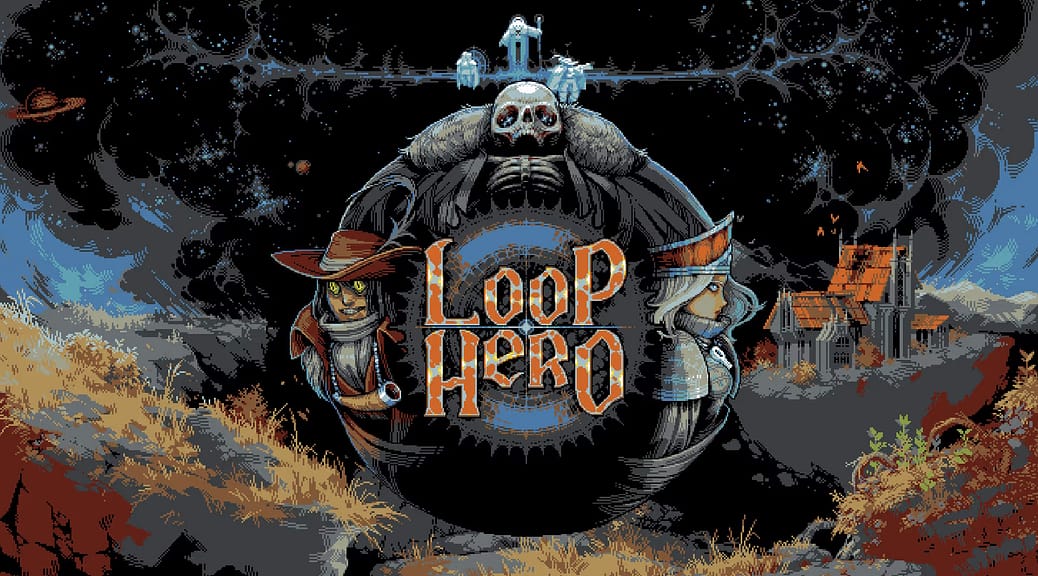
Loop Hero
One of the reasons I don’t see the prominence of the roguelike or its deckbuilding subcategory going away any time soon is that it’s an extremely open-ended genre. As long as a game has procedural generation and permadeath (and some form of randomizable item that can be shuffled into a “deck”), absolutely anything can be slotted into the numerous remaining gaps in the design document. It’s for this reason that roguelikes can lay claim to some of the most creative titles of the last 15 years, including the very-difficult-to-describe-succinctly Loop Hero. Let me put it this way: it’s like Half-Minute Hero (no relation) played on a circular track, mixed with inverse tower defence along with a base-building macrogame. And that’s before you get into the deckbuilding aspect. The base-building component is pretty pointless, but other than that, every aspect is remarkably interwoven and full-featured.
Unusually for the genre, the influence of luck is nearly absent. There are a ton of RNG-based features, but instead of governing a handful of major outcomes, they constitute hundreds of small effects and ultimately average out for a very consistent difficulty level. That level is higher than I’d prefer, but not for the reasons you’d expect. In most roguelikes with macro progression, it’s still theoretically possible to complete a run on the first try if you’re just that good or you get that one synergy that completely eliminates the challenge. Loop Hero’s gameplay being so dependent on numbers means that there are several sections that I’m pretty sure are mathematically impossible to advance through until you’ve accumulated enough upgrades. This wouldn’t be a huge problem – knowingly setting out with the intention of gathering resources to construct upgrades can be rewarding – except the cost and number of available upgrades are so high that you might not be able to construct any even after returning from a gathering mission.
This doesn’t mean that there isn’t strategy to Loop Hero. On the contrary, when you’re not aiming to defeat the next boss, you’re probably also experimenting with different build and terrain combinations, the benefits of which are made opaque enough that it’s not immediately obvious what the best tactics are but also not unknowable via scientific method. It’s just that every design element is a bit of a double-edged sword. For example, because you only have indirect impact via terrain and equipment selection, combat is more of a “set up dominoes and watch them fall” scenario, which is satisfying, because…well, go watch videos of dominoes falling; it’s pretty self-explanatory. But it also means that you’re constantly interrupting the process to micromanage your equipment. There will also inevitably be times when you’ll wish you could at least tell your avatar which enemy to target first. And while I mourn losing the anticipation of a quality attempt, it’s replaced with the arguably equally-enjoyable tension of not knowing whether you’re ready to challenge a boss when you do so.
Artistically, Loop Hero proves to be quite surprising. Its generally high-quality pixel art is apparent from screenshots, but I wasn’t expecting it to have an even higher-quality soundtrack to go with it. Although that part is slightly tainted by its barrage of uninformative and misguidedly retro sound effects. The biggest surprise is in the story. For most of the runtime, it’s merely serviceable. It has a suitably abstract premise for a game whose level design is determined by the protagonist’s half-formed memories that manifest as cards for the player’s benefit, although its dialogue struggles to maintain an appropriate tone. And then, in the final minutes of the plot, it manages to tie together all of the preceding events with the game’s seemingly non-diegetic mechanics while maintaining that palatable level of abstraction. I was getting annoyed with how artificially prolonged the game felt, but it’s hard to argue that it wasn’t worth it.