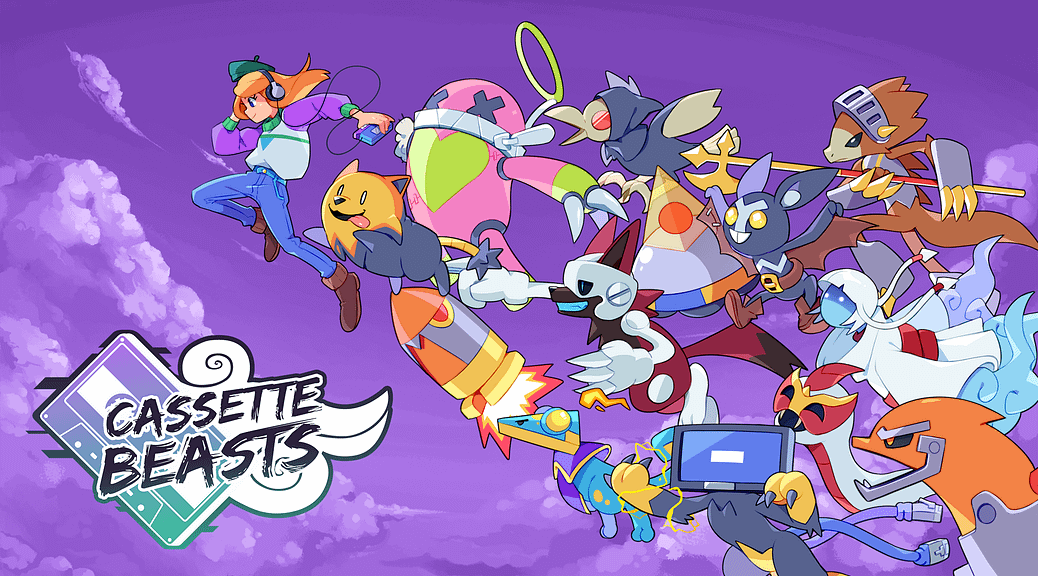
Cassette Beasts
It’s both somewhat unfair and completely accurate to call Cassette Beasts a Pokémon clone. Roughly 50% of its mechanics are one-to-one copies of things from Game Freak’s flagship franchise, while the other 50% reinvent what I would have considered staples of the genre. The importance of type matchups for damage potential is downplayed and replaced with associated status effects, including the ability to transmute a target’s type, such as using a Fire move to turn a Plastic-type into Poison. Both moves and passive effects are governed by stickers, which can be freely swapped between compatible creatures once acquired. Capturing monsters (which are unintuitively not called Cassette Beasts) depends more on actions taken during the capture turn than on the target’s initial health. And most brilliantly, it’s the human characters who gain experience from battle, so you’re free to change what monsters you have on hand regularly without any grinding.
As one of those people who regularly wishes that Pokémon would acknowledge its sizeable adult fanbase with the addition of difficulty levels (and ideally an “I have media literacy” mode), I particularly appreciate how many elements are in place to make the game satisfying for more age groups. Healing items have limited capacity, the need to expend “action points” in battle encourages a mix of low-cost status moves and expensive damage-dealers, and even the ability to fuse monsters isn’t a straight power boost, requiring careful consideration to avoid its downsides. In a slightly more extreme version of Pokémon Ultra Sun and Ultra Moon’s seemingly-forgotten best feature, the game also isn’t afraid to present opponents with ostensibly unfair advantages in order to balance the player’s ability to think. Importantly though, it doesn’t exclude casual and younger players, because enemy AI and level scaling can be individually customized.
I like Cassette Beasts a lot when it’s being a thoughtfully-designed Pokémon alternative, but I like it a lot less when it’s trying to be every other game in existence. The non-combat gameplay is essentially open-world Link’s Awakening as a 3D platformer, and there’s a Persona-esque party relationship mechanic as well. While non-linearity is generally complementary to monster-collecting, it’s largely at odds with navigating a 3D environment from a three-quarter perspective with no camera control. Additionally, nearly every overworld puzzle is solved with some variant of “find a rock somewhere nearby,” and the platforming seems to have been entirely outsourced to the physics engine, which is never a good idea. The somewhat rudimentary visuals can at least be justified as sleight of hand for a story that’s surprisingly deep and mature without becoming inappropriately dark. The soundtrack, on the other hand, needs no such qualification and is almost immediately infectious.